Sportsbook bet slip UX: fast to use, hard to misuse
Good bet slip UX on mobile means a slip that stays one tap away without covering the markets, shows single, express and system as a visible switch, lets players set the stake without typing, shows the possible return before the button and gives odds changes, suspended markets and low balance their own clear states. This is how iDesy designs it.
Key takeaways
- The bet slip turns a tap on the odds into a bet the player understands; on a phone it is the screen that decides the sportsbook.
- Show single, express and system as a visible switch, and keep the slip when the mode changes.
- Offer quick stakes next to a manual field, and show total stake, total odds and the possible return before the button.
- Design every state before the visuals: empty slip, odds changed, market suspended, not enough money, stake limits, bet accepted.
- Collapse the slip into a small bar or button so it never covers the markets the player is comparing.
- Speed helps when it shortens the player's own decision and becomes a push when the product decides for them, such as auto-accepting odds changes by default.
How a mobile bet slip should work: the short answer
Good bet slip UX comes down to one job: turn a tap on the odds into a placed bet the player understands. On a phone that means the slip is always one tap away but never covers the markets, the mode (single, express or system) is a visible switch, the stake can be set without typing, the possible return is on screen before the button, and every awkward state has its own clear message: odds changed, market suspended, not enough money, bet accepted.
At iDesy we design sportsbooks and casino platforms, and the bet slip is the screen we spend the most time on in a betting product. Below is how we approach it, with screens from Vertbet, a sportsbook, eSports and live casino app we designed.
Why the bet slip decides the sportsbook
Casino design rewards browsing. Sportsbook design punishes it. A player picking a slot has time; a bettor watching a live match does not. Between seeing a price and placing a bet there are a few seconds, and every extra tap, every keyboard that pops up, every modal that hides the markets is a chance for the price to move or for the player to give up.
That is why popular videos and articles about betting apps talk so much about speed. Speed itself is not the problem. The question is whether it helps the player do what they already decided, or pushes them into something they did not. We come back to that line at the end.
Single, express, system: one slip, three modes
Most bettors know what they want before they open the slip: one bet, an accumulator, or a system. The slip should make that choice visible and reversible, not hide it in a menu or guess it from the number of selections.
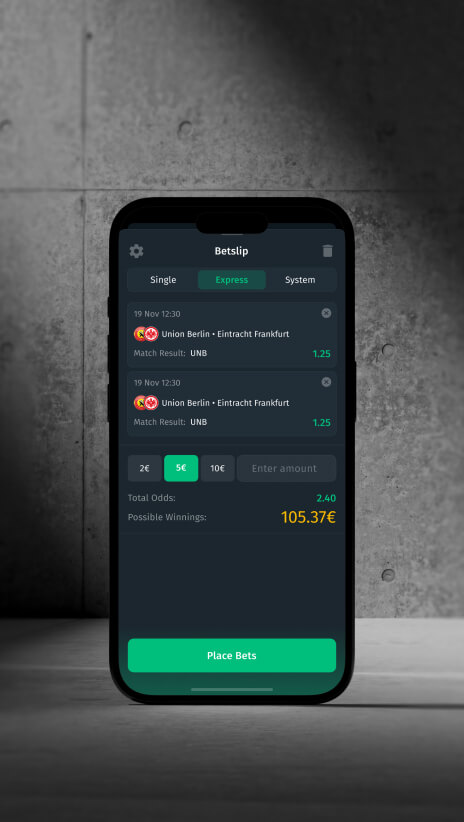
On the Vertbet slip the three modes sit at the top as a segmented switch: Single, Express, System. Each selection is a separate card with the date and kick-off time, the teams, the market and the pick, the odds, and a cross to remove it. A bin icon clears the whole slip, a gear opens the slip settings. The player can see everything they are betting on without scrolling past the stake.
Our rules for the selection list:
- Every card names the market in words (“Match Result”), not only the outcome code, so a player who added five picks can check them.
- Removing one pick takes one tap and does not reset the stake.
- When the mode changes, the totals change in place; the player does not lose the slip.
Stake entry and the return, before the button
Typing a stake on a phone keyboard is the slowest part of a bet. On Vertbet the slip offers quick stakes, 2, 5 and 10 euro, next to an “Enter amount” field for anything else. Under them the slip shows total odds and possible winnings, with the winnings in the accent colour, and only then the Place Bets button, pinned to the bottom of the screen within thumb reach.
The order matters. The player sees what they risk and what they can get back before the button, not in a confirmation after it. For system bets the slip should also say how many bets the system contains and what the total stake is, because “5 euro” on a system is rarely 5 euro in total.
The states nobody draws
A bet slip mockup usually shows the happy path: two picks, a stake, a green button. Real bets spend a lot of their time in other states, and that is where players lose trust. Before any visual work we map every state of the flow in wireframes:
- Empty slip. Explain how to add a pick, and offer a way back to popular events.
- Odds changed. Show the old and the new price on the card itself, mark the direction, and ask the player to accept the change. A silent update or a modal that throws away the slip are both wrong.
- Market suspended. Grey out that pick with a short reason and keep the rest of the slip usable; let the player remove it or wait.
- Not enough money. Say it next to the stake, show the balance, and offer a deposit that brings the player back to the same slip.
- Stake limits. Show the minimum and maximum before the player types a stake that will be rejected.
- Bet accepted. A clear confirmation with a link to the ticket, and an obvious choice between keeping the picks and clearing the slip.
Whether the player wants odds changes accepted automatically is a setting they choose, not a default the product chooses for them.
Betting app UI: keep the slip out of the way of the markets
On mobile, an open slip covers the very markets the player is comparing. The usual fix is a slip that collapses into a small bar or pill with the number of picks and the potential return, and opens to full height only when the player taps it.
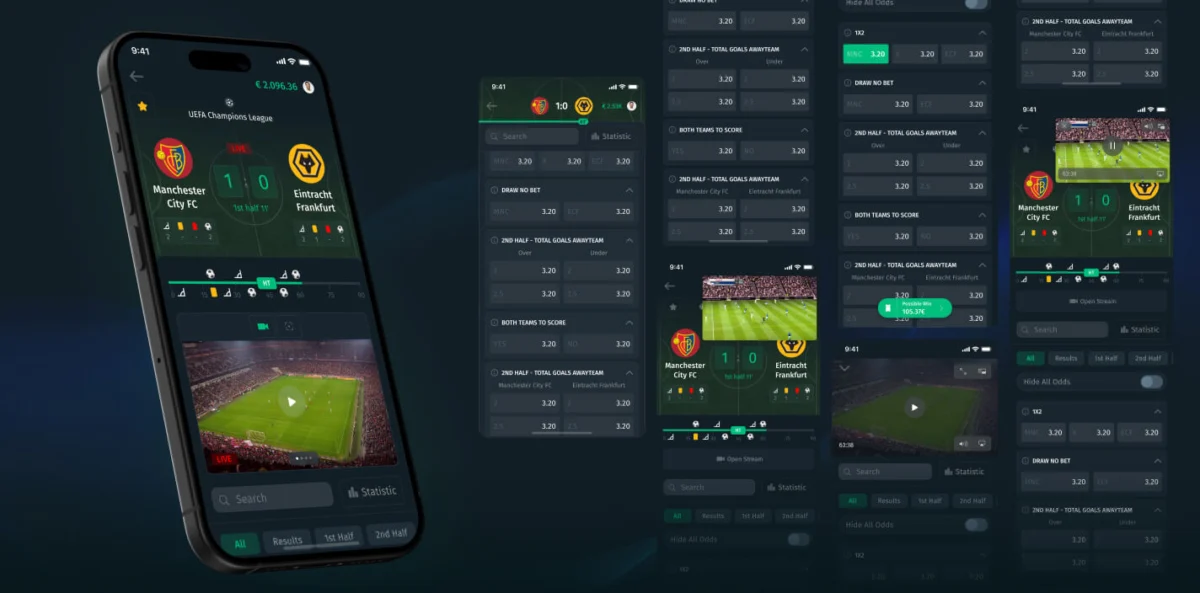
In the Vertbet live match screen the selected price lights up green in the 1X2 group, and instead of a full slip a compact “Possible Win” button with the potential return floats over the market list. The match tracker, stream, statistics and market filters stay in view. Market groups fold into accordions, and a “Hide All Odds” switch lets the player watch the match without the line.
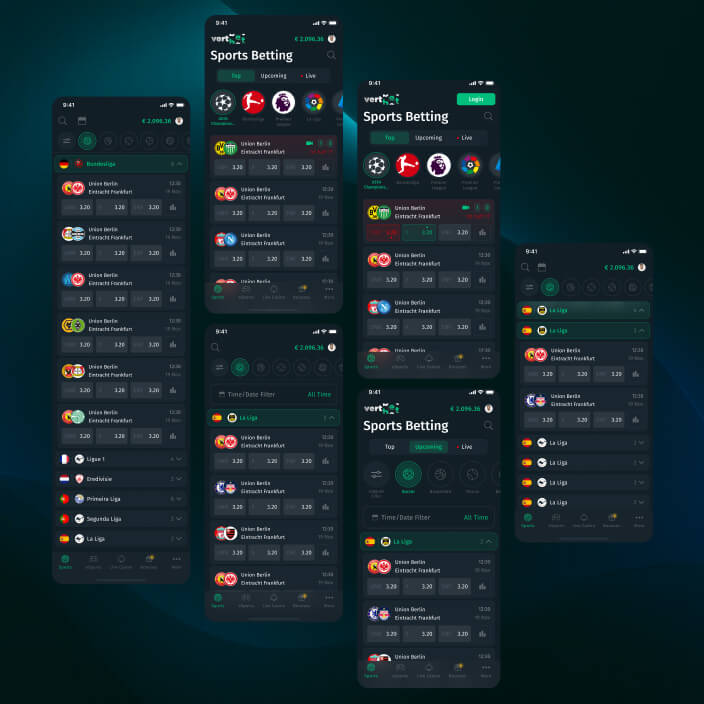
The line feeds the slip, so it is part of the same design. On Vertbet the sports screen has Top, Upcoming and Live tabs, league shortcuts, a time and date filter, and leagues that fold. Each match row carries its main odds, so the first pick is one tap from the list, without opening the match.
After the bet: a ticket the player can read
A placed bet becomes a ticket, and the ticket is where the player checks what happened. It should be readable without knowing betting codes.
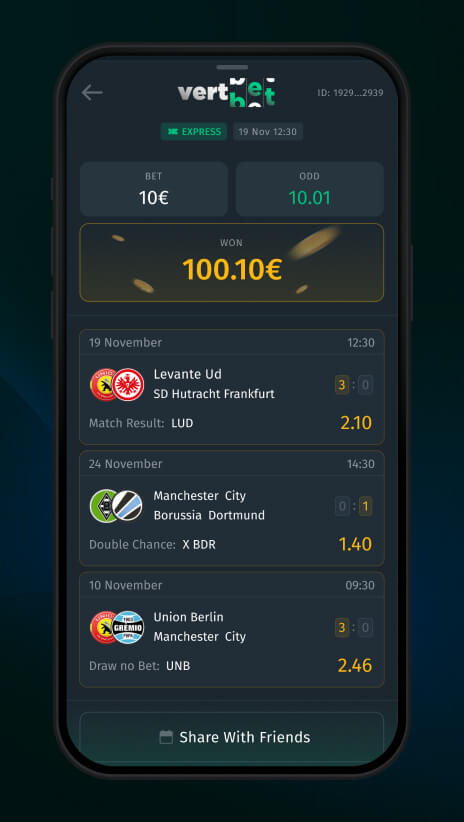
The Vertbet ticket starts with the bet type and date, then the stake, the odds and the result, and then lists every leg with the score and the market: Match Result, Double Chance, Draw No Bet. A Share With Friends button sits at the bottom. In the account menu, My Bets sits next to Deposit and Withdraw.
Where a cash-out is offered, it belongs on the open ticket itself, with the current amount shown, not three screens deep.
Fast for the player, not a push
Speed helps when it shortens a decision the player has already made: a pick from the list, a preset stake, one button. It turns into a push when the product makes the decision for them. That is the same line we drew in dark patterns in online casinos, and in a sportsbook it looks like this:
- Preset stakes that quietly grow after every bet, or a stake field prefilled with the last, bigger amount.
- Odds changes accepted automatically by default, so the player finds out the price only on the ticket.
- A “bet again” or “add to accumulator” prompt right after a loss, styled stronger than closing the slip.
- A potential return in large type while the total stake of a system bet is hidden.
The honest version keeps the speed and leaves the information in: presets the player can see and change, odds changes they accept, the full stake next to the full return, and a ticket and balance that are always one tap away.
A checklist for your bet slip
- Can a player add a pick from the event list without opening the match?
- Is the mode, single, express or system, a visible switch?
- Can the stake be set without the keyboard, with limits shown?
- Are total stake, total odds and the possible return visible before the button?
- Does the slip have designed states for changed odds, suspended markets, low balance and an accepted bet?
- Does the collapsed slip leave the markets visible?
- Can the player read a ticket without knowing betting codes?
If you are planning a sportsbook or redesigning a slip on SoftSwiss, BetConstruct or another platform, our sportsbook UI/UX design starts with exactly these states. What a project like this costs depends on its modules; we explain it in how much casino website design costs.
Frequently asked questions
How should a bet slip work on a mobile sportsbook?
It should stay one tap away without covering the markets, usually as a small bar or button with the number of picks and the potential return. Inside, single, express and system are a visible switch, each pick is a card with its market and odds, the stake can be set with quick amounts, and total stake, total odds and possible winnings appear before the Place Bet button. Odds changes, suspended markets, low balance and an accepted bet each get their own clear state.
What is good bet slip UX?
A bet slip with good UX lets a player place the bet they already decided on in as few taps as possible without hiding anything: the market in words, the stake, the total odds, the return and any price change. It keeps the slip intact when a pick is removed or the mode changes, and it explains every problem next to the place where it happened.
How should a sportsbook handle odds changes in the bet slip?
Show the old and the new odds on the affected pick, mark whether the price went up or down, and ask the player to accept the change before the bet is placed. Do not update the price silently and do not throw the player out of the slip with a modal. Accepting changes automatically should be a setting the player switches on, not a default.
What should sportsbook UI design include besides the bet slip?
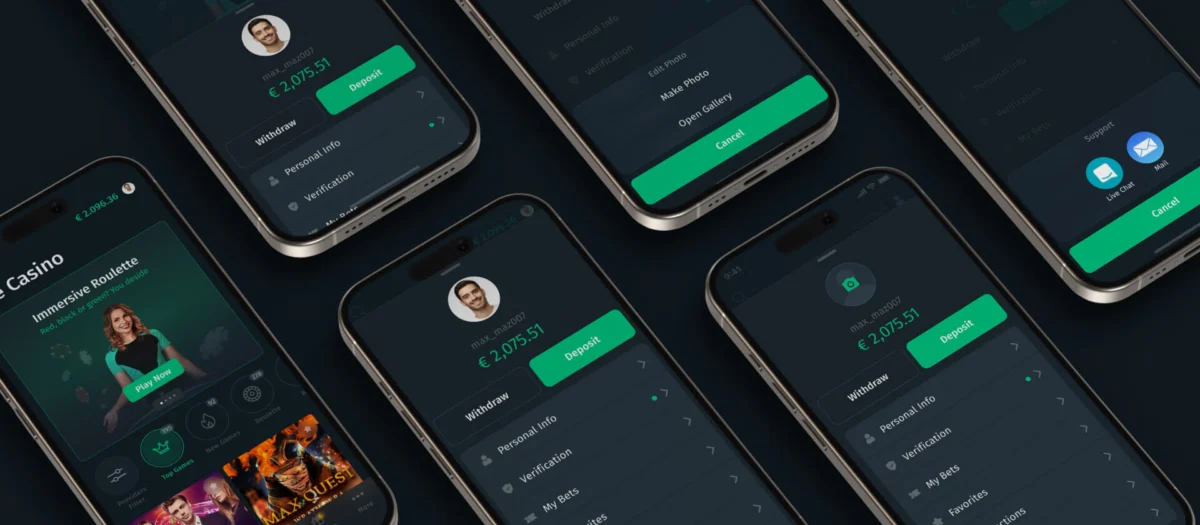
A betting line with leagues and market groups that fold, live match screens with a tracker and statistics, odds formats and movement indicators, open and settled bet tickets, cash-out where it is offered, account flows such as deposit, withdrawal, verification and limits, and bonus mechanics. iDesy designs all of these as one system with the bet slip, as in the Vertbet case.
How do betting apps make betting fast, and where does it become manipulative?
They use one-tap picks from the event list, preset stakes and a slip that is always within reach. That speed helps when it shortens a decision the player already made. It becomes a push when the product decides for them: preset stakes that grow after each bet, odds changes accepted by default, a prompt to bet again right after a loss, or a large potential return next to a hidden total stake.
How much does sportsbook UI/UX design cost?
At iDesy, designing a casino or betting platform starts from $5,000 and takes from two weeks. The final price and timeline depend on how much functionality the product has and which modules it needs, such as the betting line, bet slip, live betting, account and bonuses.