Casino cashier and withdrawal UX: what players read as trusted
Casino cashier UX earns trust when limits and fees show before the player types, the button names the amount and any bonus, a withdrawal has a review step and a visible status, and verification is explained from day one. This is how iDesy designs casino cashiers, with Woombet and Rich Prize screens.

Key takeaways
- Players check a casino's honesty at the cashier, not on the licence badge: they look for no surprises.
- Show the minimum, maximum and fee of every method before the player types an amount.
- Make the bonus a visible choice and repeat the amount and the bonus in the button text.
- Give a withdrawal a review step and a status the player can find without writing to support.
- Explain verification from the first day, with file rules and a status for each document.
- Wrong currency and low balance need their own messages inside the game, with a way forward.
Casino cashier UX: what makes it look trustworthy, the short answer
Players do not judge a casino’s honesty from its licence badge. They judge it from the cashier: whether limits and fees are shown before they type, whether the button says exactly what will happen, whether a withdrawal has a visible status, and whether verification is explained before they need their money, not after.
At iDesy we design casino and betting platforms, and the cashier is where trust is won or lost in every one of them. Below is what we put on those screens, with examples from Woombet, a crypto and fiat casino with a sportsbook, and Rich Prize.
“Which online casino is legit for real money?” What players check at the cashier
In the ChatGPT question data we collected on 21 October 2026 (DataForSEO, US English), “what is the most trusted casino online for real money?” alone has about 1,185 searches a month, and “which online casino is legit for real money?” about 707. The assistant answers with review sites and lists. The player then opens the casino and checks the answer against the cashier. What they look for is simple: no surprises.
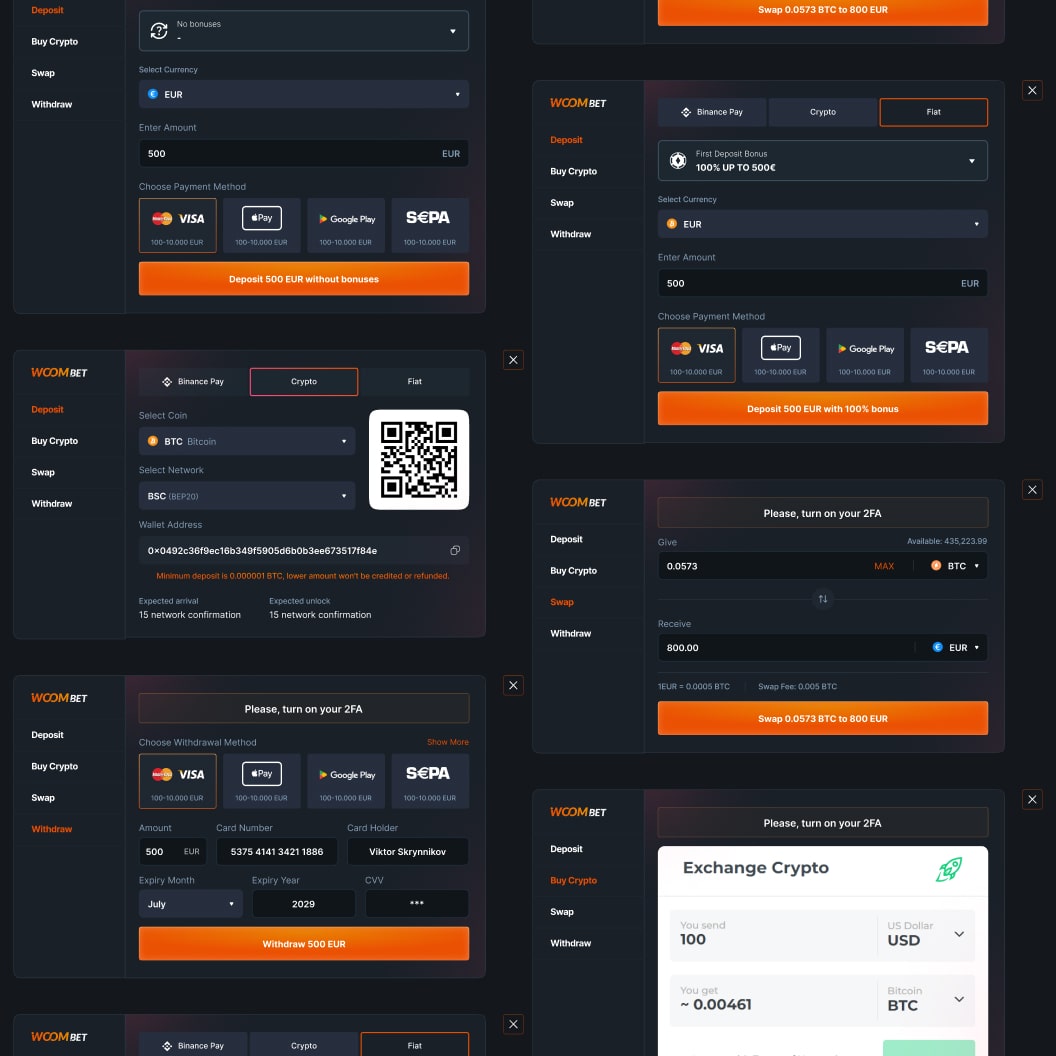
On the Woombet cashier every payment tile shows its range, 100–10,000 EUR, before the player picks it. The bonus is a visible choice, “No bonuses” or “First Deposit Bonus 100% up to 500€”, and the button repeats that choice in words: “Deposit 500 EUR without bonuses” or “Deposit 500 EUR with 100% bonus”. Nobody accepts a bonus they did not notice, which is also where most wagering complaints start. The swap screen shows the rate and the swap fee before the button.
“Which online casinos pay out immediately?” Casino withdrawal UX, step by step
“What online casino lets you cash out instantly?” and “which online casinos pay out immediately?” are really one question: will I get my money, and when. A designer cannot make payments faster. What the design can do is make the wait readable.
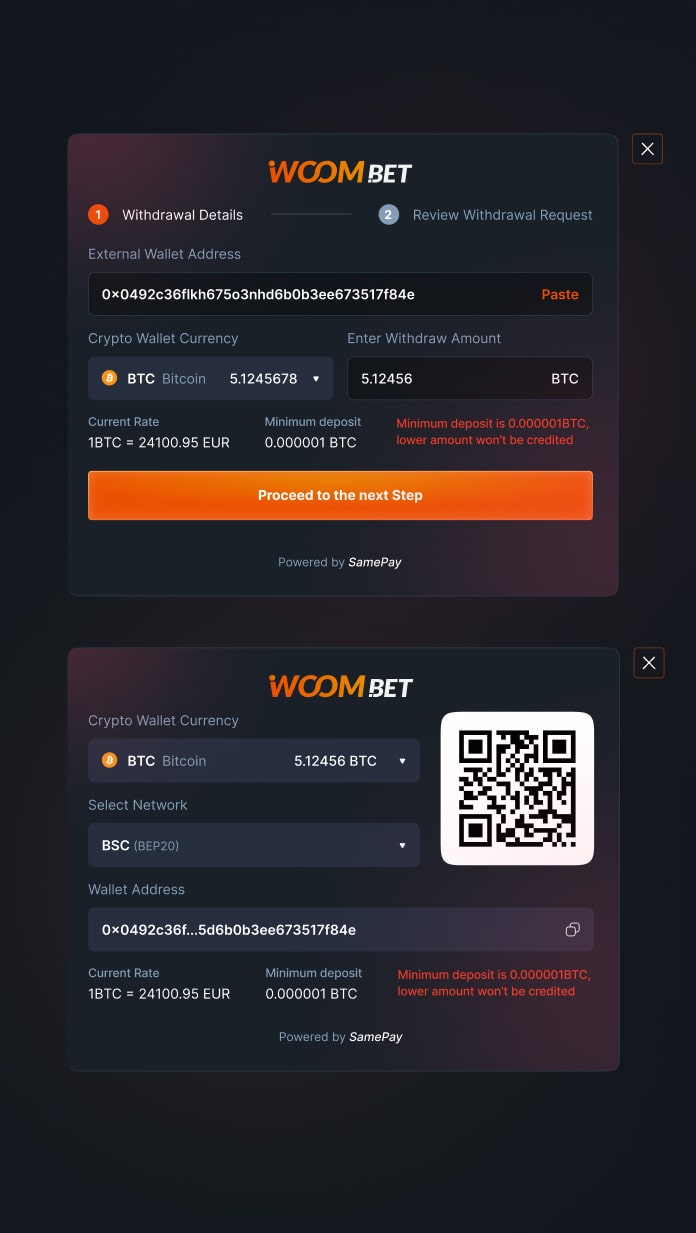
The Woombet crypto withdrawal is split into two steps, “Withdrawal Details” and “Review Withdrawal Request”, so the player checks the address and the amount before anything is sent. The current rate and the minimum sit next to the amount, and a warning in red says what happens below the minimum. On crypto deposits the cashier shows “Expected arrival” and “Expected unlock” in network confirmations.
For the time after the request we design a status the player can find without writing to support: requested, in review, approved, sent, and a rejected state with the reason and what to do next. Each status shows the method, the amount and the time of the last change. The exact timings come from the operator’s payment team; the design only shows them honestly.
KYC before the first withdrawal: ask early, explain the steps
The worst moment to ask for documents is when a player has just won and pressed Withdraw. A verification screen that appears only then reads as an excuse not to pay. We move the explanation forward: the account shows the verification status from the first day, and the cashier says that a withdrawal needs it.
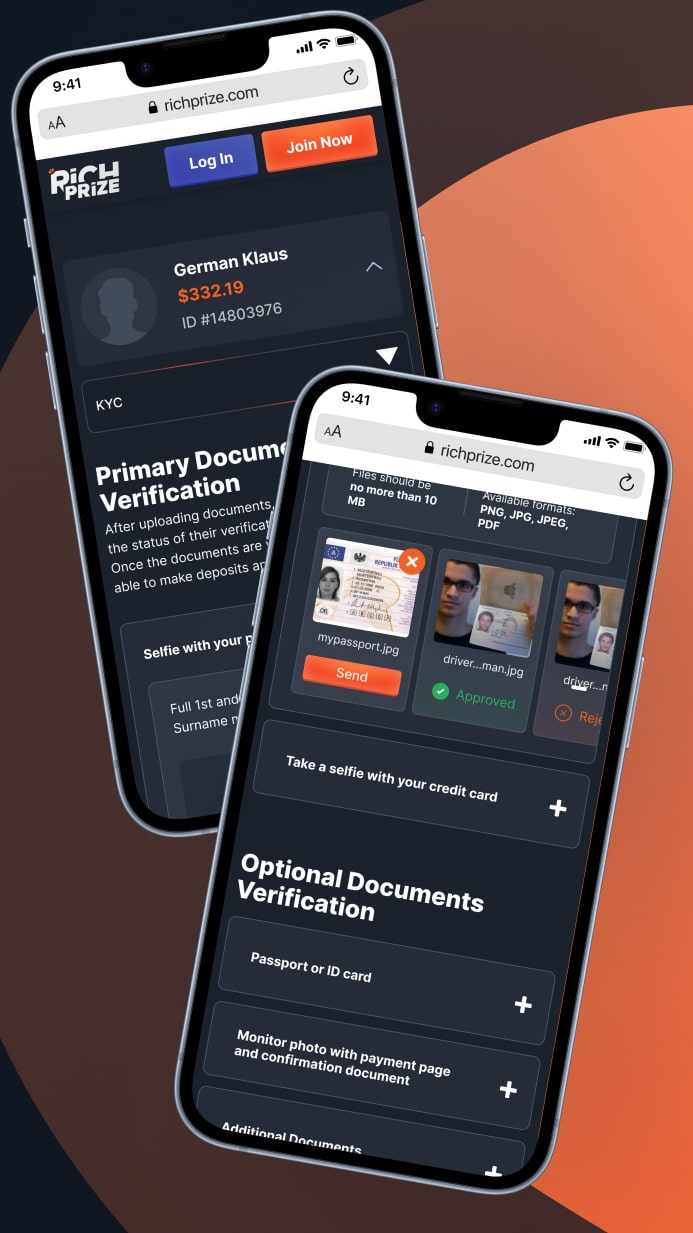
On Rich Prize the KYC section sits in the player’s account. It states the file rules up front, no more than 10 MB and PNG, JPG, JPEG or PDF, and each uploaded document has its own state: ready to send, approved or rejected. Primary documents are separated from optional ones, so the player sees what is required and what is not.
Wallet states players should never meet as a surprise
Trust also breaks inside the game. A player opens a slot with a balance the game cannot use, or with too little money, and the product either fails silently or throws them back to the lobby.
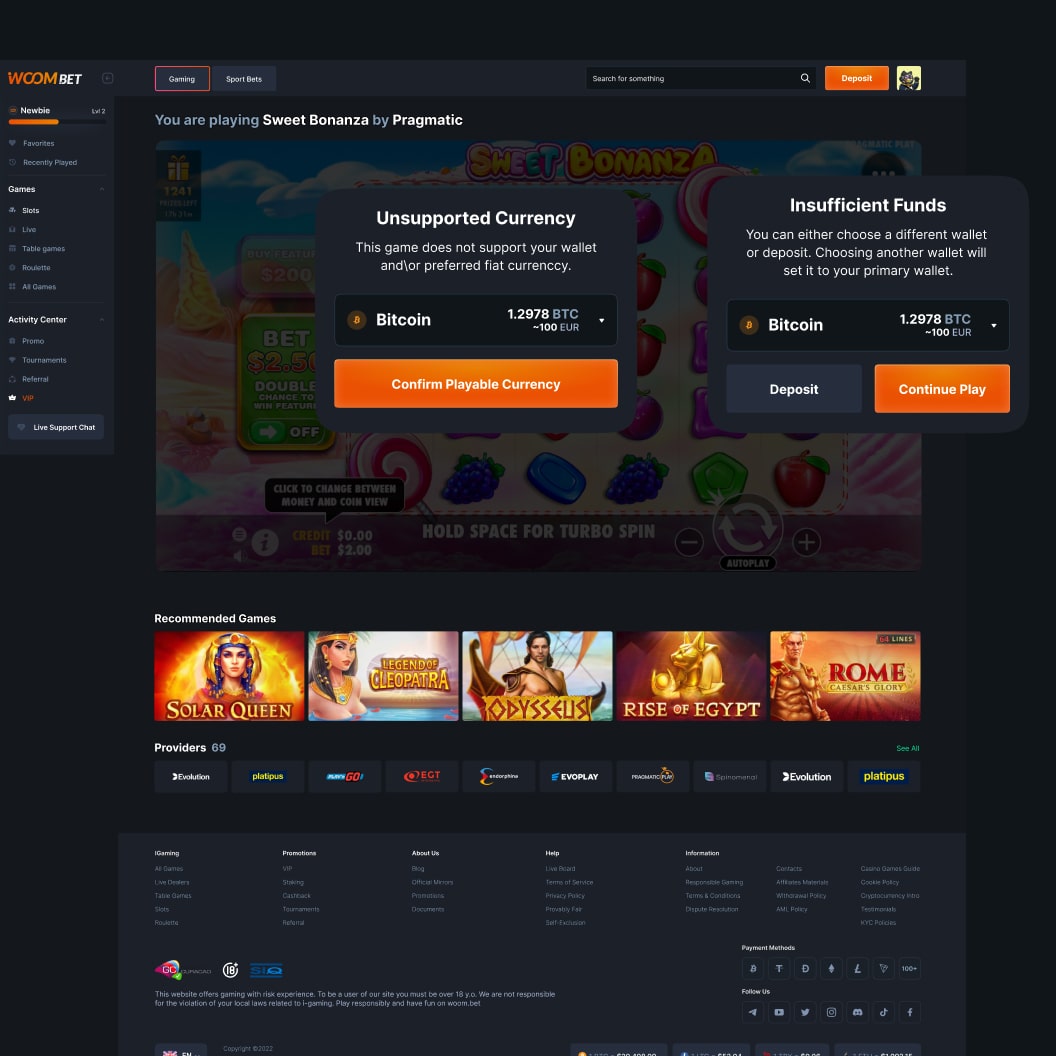
Woombet gives both cases their own message on the game page. “Unsupported Currency” explains that the game does not take the player’s wallet or fiat currency and offers a playable one. “Insufficient Funds” offers two ways forward, another wallet or a deposit, and says that choosing another wallet makes it the primary one. The player stays on the game instead of starting over.
Trust signals at the cashier, at a glance
| Signal | What the player sees | Example |
|---|---|---|
| Limits before input | Minimum and maximum under each method | Woombet: 100–10,000 EUR on every tile |
| Honest button | Amount and bonus in the button text | Woombet: “Deposit 500 EUR without bonuses” |
| Rates and fees | Rate and fee before confirming | Woombet swap: rate and swap fee |
| Review step | Check the address and amount before sending | Woombet: two-step crypto withdrawal |
| Arrival time | Expected arrival and unlock | Woombet: network confirmations |
| Security | 2FA prompt on withdrawal | Woombet: “Please, turn on your 2FA” |
| Verification | File rules and a status per document | Rich Prize: Approved, Rejected |
A checklist for your cashier
- Every method shows its minimum, maximum and fee before the player types.
- The bonus is a visible choice, and the button names the amount and the bonus.
- Withdrawal is as easy to find as deposit, in the same cashier.
- A withdrawal request has a review step and a visible status afterwards.
- Rejected requests say why and what to do next.
- Verification status is in the account from day one, with file rules.
- Wrong currency and low balance have their own messages inside the game.
What not to do at the cashier is covered in dark patterns in online casinos. If you are building or redesigning a cashier, our casino UX/UI design starts with these states, before any visual style.
Frequently asked questions
What makes an online casino look trustworthy when players deposit and withdraw?
A cashier without surprises: the minimum, maximum and fee of each method are shown before the player types, the bonus is a visible choice, the button names the amount and the bonus, a withdrawal has a review step and a visible status, and verification is explained before the first withdrawal. Players read these details as signs that the casino will pay.
Which online casinos pay out immediately?
Payout speed depends on the operator, the payment method and verification, not on design. Design decides whether the wait is readable: a casino that shows the expected arrival time, the status of each withdrawal request and the reason for any delay looks faster and more reliable than one that shows nothing.
Which online casino is legit for real money?
Answer engines point to licences and review sites. When players open the casino, they check the cashier: clear limits and fees, an honest deposit button, withdrawal in the same place as deposit, and a verification process explained in advance. For an operator, those screens are where a player decides whether to trust a recommendation.
When should a casino ask for KYC documents?
Explain it early. Show the verification status in the account from the first day and say in the cashier that a withdrawal needs it. A verification screen that appears only after a win reads as an excuse not to pay. List the file rules up front and give each document its own status: sent, approved or rejected with a reason.
What should a casino withdrawal screen show?
The method with its minimum and maximum, the amount, any fee or exchange rate, a review step before sending, and after the request a status: requested, in review, approved, sent or rejected with the reason. Security prompts such as 2FA belong on this screen too, before the player starts filling it in.
How much does casino cashier design cost?
At iDesy, designing a casino platform starts from $5,000 and takes from two weeks. The final price depends on the functionality and modules: a cashier with crypto and fiat, swaps, verification and withdrawal statuses is a bigger scope than a single deposit form.